By Admin
Source: Leaderonomics
This is the first in a series of articles that explore the impact of the 4th Industrial Revolution on modern society. To understand this phenomenon requires that we think beyond the concept of digital and take a closer look at how the digital space impacts the human space.
In the past 150 years, technology has grown exponentially and now that we are literally catching up with ourselves so that we can effectively operate in a world where we have become increasingly reliant on machines not only for comfort, but for survival, it is time to stand still and contemplate what that means for us when it comes to earning a living.
In 1984, did the directors of the movie Terminator have a premonition of the future?
The Terminator is a science fiction film that was released in 1984, directed by James Cameron and starring renowned actor-turned-politician Arnold Schwarzenegger.
Lessons from the future brought to life in Hollywood—is the future made on the stage?
Schwarzenegger plays the role of a cyborg assassin sent back in time from the year 2029 to 1984 to kill Sarah Connor, whose son John Connor would one day lead the rebellion against machines in a post-apocalyptic future. Yes, you read right, the cyborg assassin was sent back from the year 2029, which is only 10 years from now. John’s father, Kyle Reese, was sent back in time to protect Sarah and safeguard the upcoming birth of his son which would ultimately result in saving humanity from extinction by machines.
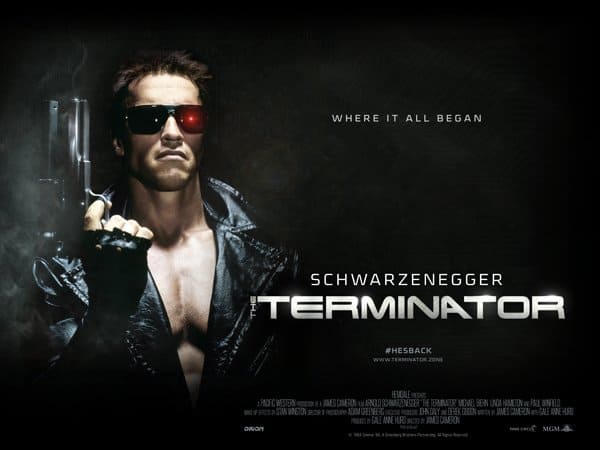
Undoubtedly, scenes from a science fiction movie such as The Terminator characterise the darker side of what we have come to know as the 4th Industrial Revolution, which involves the fusion of technologies, and which is responsible for blurring the lines between physical, digital and biological spheres also collectively known as cyber-physical systems. Ultimately, what comes across in this film are scenes of a world run by machines who want nothing more than to eradicate humanity and run the world themselves.
The fact of the matter is that whether we like it or not, today, we are controlled by machines. Not to say that they are about to turn the tables and kill off the human race, but, without them, it is very difficult – if not near to nigh impossible – for us to survive the demands and challenges of the modern era.
What does the 4th Industrial Revolution involve?
The 4th Industrial Revolution has a broad signature across many different fields with technology breakthroughs in numerous disciplines including:
- Fully autonomous vehicles
- Robotics
- The Internet of Things
- Industrial Internet of Things (IIOT)
- Fifth-generation wireless technologies (5G)
- Additive manufacturing/3D printing
The 4th Industrial Revolution is different from the previous three eras in that instead of being marked by technological advances, it is concerned rather with advances in communication and connectivity. Such technologies hold the potential to further connect billions more people to the web and significantly enhance business and organisational efficiencies as well as helping to regenerate the environment using improved asset management techniques.

Buildup to the 4th Industrial Revolution
It is not difficult to see how the build up to the 4th Industrial Revolution has its roots in the 3rd Industrial Revolution or Digital Revolution, which deals with how fundamental economic change happens with the rise of three types of technological advances, that is:
- How goods or humans are moved
- How we communicate and manage information
- How we power our economies
The 3rd Industrial Revolution therefore was primarily concerned with transformative potentials involving:
- The Internet of Things and 5G networks
- Automated driving
- Renewable energy
The digital revolution began during the 1980s and the birth of its ‘children’, the personal computer, the internet and information and communications technology was therefore responsible for the advancement of technology in terms of moving from analogue electronic and mechanical devices to what we have today.
Read: Does Every Company Need To Be A Technology Company?
Recap on the first two stages of Industrial Revolution
The First Industrial Revolution occurred during the 18th and 19th centuries in Europe and North America with the agrarian, rural societies becoming industrial and urban. The textile and iron industries as well as the advent of the water wheel followed by the steam engine were core drivers of the Industrial Revolution.
The Second Industrial Revolution occurred between 1870 and 1914 prior to World War 1. It marked a growth period for pre-existing industries as well as expansion into new industries such as electricity, steel and oil, and electric power was used for mass production. This period was responsible for significant technological advances such as the internal combustion engine, the telephone, the light bulb and the phonograph.
Read and write versus tap and swipe
A world run by machines means that we need to work hand in glove with these machines. Nowadays, the launchpad for education and training in the modern world starts off with children in their first year of schooling using a tablet instead of a pencil and paper to learn to read and write. Today, children first learn to tap and swipe on the tablet before they learn to read and write.

We have accepted this although we may not be able to relate to how children these days even have their own digital footprint by the age of two! This poses even further challenges for us in that before we know it, our children will have mastered the world without us being involved since everything they learn at school takes place in a digital environment.
You may be interested in: Is Education Keeping Up With Industry 4.0?
Skill up for the 4th Industrial Revolution
So, how do we skill up for the 4th Industrial Revolution to meet our needs and the needs of the world at large in a machine-run world? It is simple enough to grasp that what we ultimately need to bear in mind is that technology training, computer skills training and anything involving understanding how digitisation affects our daily lives will do the trick, at least for now.
The next article in this series deals with the impact of training humans in a world run by machines. Not to be missed!
Read also: Here’s How You Should See The 21st Century Talent For 4th Industrial Revolution
Helen Fenton is currently a Senior Analyst at Business Optimization Training Institute (BOTi) in Johannesburg, South Africa. She is passionate about her work as a writer and author. Having spent a total of 25 years with Standard Bank of South Africa, Helen’s business roots are in the financial services sector. Also with 20 years of experience in corporate marketing, she has performed numerous roles within the bank involving marketing communications, focused on brand, advertising and creative services.
Reposted with permission on Leaderonomics.com
See it on your own numbers.
Start free, import your team, and run a cycle on real hours. Nothing is filed until you approve it.
Sign up for free