By Marjan Bojadjiev
Source: Leaderonomics

How can we preserve the effective organisational culture and make it more effective in spotting opportunities?
Organisational culture in times of crisis
When the COVID-19 crisis started, I googled the phrase ‘organisational culture in times of crisis’ and ‘leadership in times of crisis’. I was surprised that I couldn’t find much literature review. But I have a sound managerial experience paired with extensive leadership experience in this crisis, so I might share with you my experiences and views on this matter.
My main idea is the following: How can we preserve effective organisational culture and, what is more, how can we make it more effective in seizing opportunities?
“Culture makes or breaks…” was a quote by John F. Kennedy.“The Chinese use two brush strokes to write the word ‘crisis.’ One brush stroke stands for danger; the other for opportunity.”
This was actually an error by JFK, but it emphasised the importance of opportunity in crisis. Even more, this is very much aligned with my way of thinking; namely, I believe success means:
- Finding and seizing the opportunities clouded in threats, and
- Converting weaknesses into strengths
What is organisational culture, leadership, and what are the culture and leadership types?
I define culture as ‘an unwritten system of values and norms that determines interactions, behaviours, decision making, and processes within the organisations.’
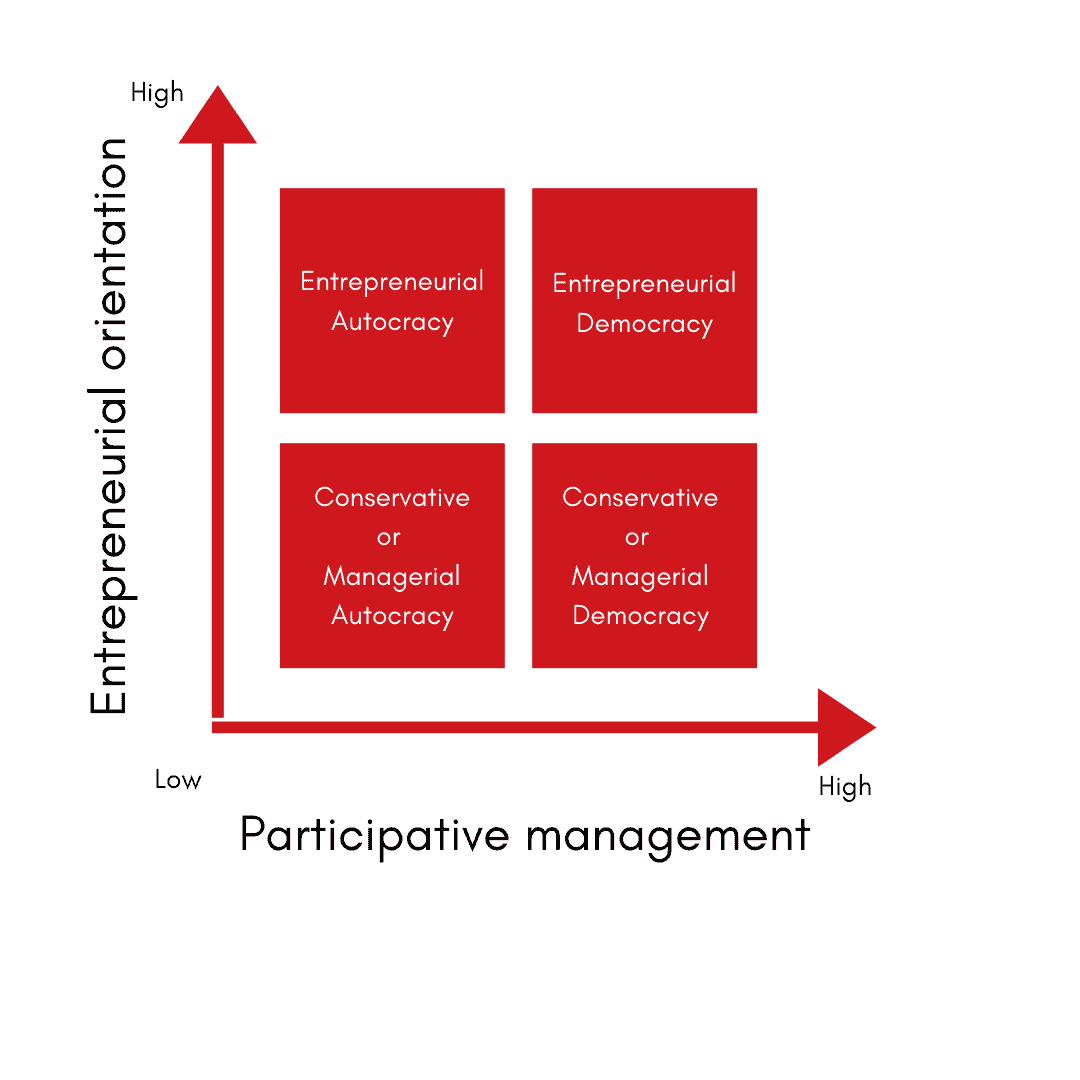
My model is called 4CT, meaning four culture types based on two dimensions:
- The way decisions are made in organisations: democracy and autocracy, and
- Openness to risk: entrepreneurial and managerial (or conservative firms)
We can differentiate four types of organisational culture as presented in the following graph:
How to sustain organisational culture in times of crisis?
1. Be consistent
In other words, in times of crisis, behave like you would have behaved in peaceful times.
In 2011, theUniversity American College Skopje, which I manage,had a tremendous drop in enrollment due to government policy. Namely, the government of the Republic of Macedonia decided to open state universities in many towns, and their opening halved our revenue. We had to downsise and cut salaries. At the Strategic Planning Town Hall with members of the university family (faculty and staff), I presented two slides:


The message was simple:
- We used to be a big boat. Now, we are a small boat. But, being small, makes us more flexible, faster and more resilient.
- The Rolling Stones are a great band. They’ve been together for many years and they make fantastic music. If we stick together, we can be on the market for many years and we can make fantastic music – good education.
As I said, the message was simple: we are all together in this small boat.
Now, in 2020, I did the same.
Read: Thriving in a VUCA World: Acceleration at the Speed of Change
2. Lead from the heart
When explaining ‘leading from the heart’ to my students, I use the example of Scottish heroWilliam Wallace, at least the way he’s depicted in the movie Braveheart. No matter whether one leads an army, a non-profit organisation or a business, one needs to lead from the heart.
3. Be passionate
Business activities in times of crisis differ from those in normal times. While in normal times they are complex, intentional and passionate, in crisis they are much more complex, much less intentional and much more passionate.One cannot motivate the followers to go beyond and above the call of duty without passion.
4. Lead by example
The Archbishop can’t be a bishop; much less an Archbishop without serving every day; Cristiano Ronaldo couldn’t be the captain of Portugal’s football team without scoring goals, and no leader will be deemed relevant without: leading, executing, and being on the front line and present when needed.
I started my first online class on March 11. The second professor was the vice-rector, Marjan Petreski, who taught the very next day. In one week, we had the whole organisation ready to go online.
5. Care for followers
When the crisis started, I got a call from Dr Laszlo Dux, the Hungarian ambassador to Macedonia, checking if I was OK, and saying that if I needed anything, I could call him or the embassy.The Ambassador was personally calling everyone from the Hungarian community to check on them. I am an Honorary Consul of Hungary for Southwest Macedonia, so I’m considered a member of the Hungarian community.
Caring about followers is no ‘quid pro quo’ – no, this is serious care for the people you are responsible for. This is the only way to build trust.
This roll call had a powerful message – the leader of the community is here, cares for his people, and offers himself ( or herself) if needed.
6. Build trust, build followers
One of the stories I use to explain the powerful message of caring about others is the Battle of Neretva or ‘Case White’. It happened in early 1943, involving Partisans (Yugoslav militia) led by Tito, and German, Italian and local collaborators. In this battle, Tito made a few epic tactical manoeuvres, destroying and rebuilding the bridge over the Neretva Riverjust to save 2, 500 wounded in the column. But this action inspired the myth and built trust in him.
It’s similar in today’s organisations. Caring about followers is no ‘quid pro quo’ – no, this is serious care for the people you are responsible for. This is the only way to build trust. This is why I define leadershipas a process of a leader’s influence on followers in which the latter voluntarily accept stimulus from their former.
7. Be brave & take risks
Being brave means taking risks; at least, the one you find acceptable. Bill Clintonbailed out Mexicoand prevented potential unrest on the U.S. border in 1995.
“Hey, guys, I think we can build this rocket ourselves.”, Elon Musksaidon the flight back from Moscow. And then, after he started SpaceX, he said: “Creating a rocket company has to be one of the dumbest and hardest ways to make money. If it was about money, I’d just start another Internet company.”
8. Use open and effective communication
Preserving winning organisational culture is impossible without honest and open communication. But it has to be effective communication, too. How to provide effective communication, when we can’t use the richest communication channel – face to face? Well, we have to be even more effective with the other channels and more careful with the design of communication messages.
Here is a suggestion based on theAristotle Rhetorical Triangle:
- Beware of: Ethos, Logos and Pathos.
- The simple formula is: A short emotional appeal, backed by facts, works if you have previously built personal credibility.
- If you have previously built your credibility (Ethos), you have credit to persuade your followers by facts and logic (Logos). Aristotle believed that ‘Logos’ is the key.Others, including the author, believe that the most important part of the message is the emotion (Pathos).
To be even more specific: for me, effective communication is clear and emotional. One cannot fake emotion, but one can openly express them: fear, apprehension, joy, excitement, courage–these are all things that cannot be hidden. If delivered properly, this is the key to inspiring leadership.
How to make your culture work for you to uncloud opportunities?
In the Introduction, we have established that success means:
- finding and seizing the opportunities clouded in threats, and
- converting weakness into strengths
Crisis is another word for opportunity. The University I manage is working hard to prepare itself for the global market. By learning how to teach online, we learnt how to market ourselves to the whole world.

Tesco posted a respectable £2.96 billion in annual profit recently, up 13.5% from the year prior.Cash flow is also upsome 132% to £2.1 billion. Netflix isgrowingin ‘corona times’. One might counter by saying the whole streaming industry is growing, but Netflix is outpacing all its competitors. What I am suggesting is that, in any given circumstances, there will be relative winners and relative losers.
The question is: How can we utilise the culture of our organisation to achieve these goals? And which culture type is best suited for times of crisis? Here are some tips:
Challenge your followers
It is a cliché to say your people are your most important asset. It is not cliché to say: your people, when challenged and when stretched to their maximum limits, are your most important asset. But even more, people become your asset, butthey become their own asset as well, since they are members of the upgraded organisation.
So, my suggestion is: challenge your followers. Not to exploit them – but to unleash their potential.
Trust your followers
I quoteGeneral Patonhere: “Never tell people how to do things. Tell them what to do and they will surprise you with their ingenuity.”
Trust in human relationships goes in two directions. The idea that a leader must be trustworthy is familiar. That he also needs to have the capacity to trust others is less intuitively obvious, but the capacity to trust is essential.

I believe it is needless to say the importance of this thought today. Without personal contact and face to face communication, your best ideas are only as good as they are understood and executed by your followers.
Stand behind any mistake
Of course, we should be more specific and say: “Stay behind any reasonable mistake made within the authorisation and without any legal or ethical breach” But, we still need to show by example that we trust our followers. The bottom line is that we have chosen them. And they have chosen us.
Epilogue
Coming to the end of my deliberations, let me share a few thoughts and reach my conclusion. I believe that the most efficient organisational culture type is ‘entrepreneurial democracy’.This means an organisation which is:
- Open to risk and new experiences,
- Engages in participative decision making, and
- Has a warm work environment and the organisational structure is considered an open one.
As Jack Welch said, leadership is ‘4E-s and 1P’. One of the most important Es stands for ‘execution’. You can be the most hard-working and good-looking, but without execution, you’re irrelevant.
See Also: Compassionate Leadership Creates A Competitive Edge
See it on your own numbers.
Start free, import your team, and run a cycle on real hours. Nothing is filed until you approve it.
Sign up for free